

As a digital consultant, my mission is to simplify digital marketing for small and medium-sized enterprises (SMEs) so they can take control of their online presence. One of the most critical areas in digital marketing is Search Engine Optimization (SEO). To measure the effectiveness of your SEO efforts, it’s essential to understand Key Performance Indicators (KPIs). In this article, we’ll explore the main KPIs you should focus on to ensure your SEO strategy is on the right track, how they work together, and what they mean for your business.
What is a KPI
KPIs are quantifiable measurable values used to assess the performance of specific business objectives. The KPIs are used by the business to analyse progress and make decisions.
Business KPIs will vary between projects and specific business areas. For example, a sales team will not have the same department KPIs as a customer service or a production team.
What is an SEO KPI
KPIs are no different for SEO, they are used to track the performance of your optimisation efforts. Giving you insight into evaluating visibility, engagement and overall performance of your SEO campaign while giving you the ability to monitor and refine your strategy to achieve better results.
SEO KPIs
1. Impressions
Definition: An impression is counted every time your results are displayed to users within a search engine.

Why It Matters: Impressions give you an idea of your reach and how far your message is getting. They are the starting point and should be used in conjunction with your other KPIs.
How to Measure: These stats can be found in your Google and Bing Search Console.
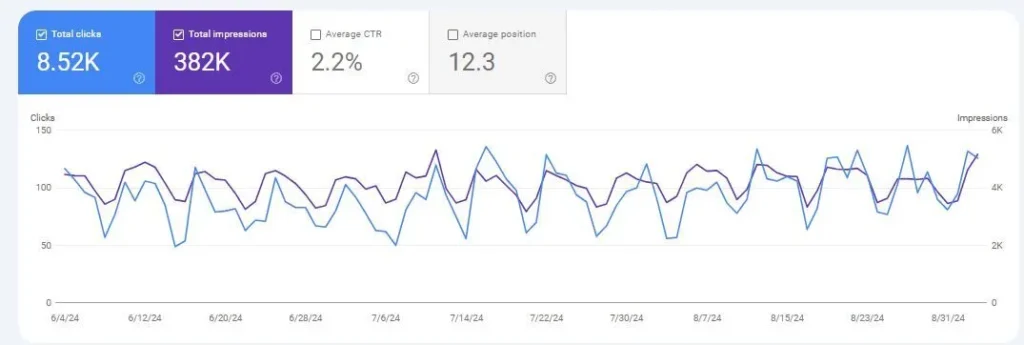
Analysis:
– If your impressions increase and your clicks increase, good job!
– If your impressions increase but your clicks decrease, you aren’t showing for the right keywords for your business.
– If your impressions go down but your clicks increase, then you are appearing for more efficient keywords.
2. Clicks
Definition: Clicks illustrate how many people are clicking on your results.
Why It Matters: Clicks indicate user interest and engagement. Comparing clicks with other metrics, such as conversions and engagement rate, helps determine the relevance of the traffic.
How to Measure: Figures from Search Console will differ from those in Google Analytics, as Search Console picks up all clicks, even if a user changes their mind and doesn’t progress to your site.
Analysis:
– If you are driving more clicks but your conversions aren’t increasing or your engagement rate is down, you are likely not appearing for the most relevant terms.
– If your engagement rate or conversions remain the same or increase, then you are sending relevant traffic to your site.
3. Click-Through Rate (CTR)
Definition: CTR is calculated by clicks divided by impressions.
| A | B | C | |
| 1 | Clicks | Impressions | CTR % |
| 2 | 690 | 5000 | =A2/B2 |
Why It Matters: This is a key barometer of the relevancy of the keywords you are ranking for. A higher CTR indicates that your meta titles and descriptions are compelling and relevant to searchers.
How to Measure: Google Search Console provides data on CTR for your search queries.
Analysis:
– If your CTR goes up, you are moving in the right direction.
– If it goes down, your relevancy is not right. You need to check which keywords you are ranking for and if any are irrelevant to your business.
4. Average Position
Definition: The average position from Google Search Console looks at your overall average position of all the keywords that you are ranking for. The lower your average position, the better.
Why It Matters: This KPI provides a general overview of your keyword rankings. Tracking the average position by keyword and grouping them at a more granular level offers a clearer picture.
How to Measure: Google Search Console groups all your keywords, up to 1000, into this figure.
Analysis:
– Your objective is to get as many keywords into the page 1 position as possible.
– If you are focusing on new keywords, you may have many keywords ranking in low positions initially, which is fine as you are building on them.
5. Organic Traffic
Definition: Organic traffic refers to visitors who come to your website through unpaid search results. Unlike clicks mentioned above these are actual users that have come through to your site.
Why It Matters: This KPI indicates how well your website is ranking for relevant keywords. An increase in organic traffic suggests that your SEO efforts are driving more visitors to your site.
How to Measure: Use tools like Google Analytics to track the number of visitors coming from organic search.
6. Conversion Rate
Definition: Conversion rate is the percentage of visitors who complete a desired action on your website, such as making a purchase or filling out a contact form.
| A | B | C | |
| 1 | Clicks | Orders | Conversion rate % |
| 2 | 690 | 50 | =B2/A2 |
Why It Matters: This KPI directly measures the effectiveness of your website in achieving business goals. Higher conversion rates mean your SEO efforts are attracting the right audience.
How to Measure: Use Google Analytics to set up and track goals. Monitor the conversion rates for different traffic sources and pages.
7. Local SEO Performance
Definition: Local SEO performance measures how well your business ranks in local search results and maps.
Why It Matters: For SMEs, local customers are often the most valuable. Optimizing for local search can drive more foot traffic and local inquiries.
How to Measure: Track your rankings in local search results and Google My Business insights to monitor local search performance.
Conclusion
Understanding and tracking these SEO KPIs will help you measure the success of your SEO efforts and make informed decisions to improve your online presence. As an SME, focusing on these key metrics will enable you to take control of your digital marketing strategy and achieve your business goals.
If you have any questions or need further assistance with your SEO strategy, feel free to reach out. Together, we can make digital marketing simpler and more effective for your business.