
Many businesses use email marketing as a key part of their marketing retention strategy, it is a great way to keep your customers engaged which will ultimately lead to more sales. The corner stone to a great email campaign is personalising your content to your audience. Here we are going to discuss some ways that you can tailor your email campaigns to increase engagement.
Understanding your customer
Before you can provide relevant information, you need to understand your customer. Creating detailed personas for your main customer groups and identifying those that are your priority will help you to provide them with the most relevant information.
Learn more about the significance of understanding your customer and gain insights into crafting effective customer personas Your customers and market dynamics will change and so will their priorities it would be recommended to refresh your data.
Personalising email content
Now that you understand your customer you can start to segment and personalise your email content to suit your personas.
Tone of voice
Maintain a consistent and appropriate tone of voice in your emails. Understanding the communication style that resonates with your audience enhances the effectiveness of your messaging. A friendly and conversational tone might be suitable for a B2C audience, while a more formal tone may resonate better with a B2B audience.
If you use the wrong tone of voice, you may turn them off you. Very simply if your target customer is very formal and official, using a casual tone of voice may prevent them from engaging any further.
When to send your emails
Timing is crucial in email marketing. Understand your customers’ behaviours and preferences to determine the optimal times for sending emails. This ensures that your messages are received when they are most likely to be opened and engaged with.
This will be different for every business and who they are targeting. B2B email subscribers will perform very differently to a B2C email subscriber. A B2B subscriber will be mainly interacting with your email during their working day whereas B2C subscribers will generally be interacting with their email outside of their business hours.
Why not test which days and times are right for your business. In this article you can see how Professional choice increased the number of clicks by 46% by choosing the right day to send their email – Find out more about the best time to send an email newsletter?
If you are not sure which days and times to start, take a look at your analytics to see which times and days are the most popular for your website.
Previous buying patterns
If you are emailing existing customers as part of your customer retention activity, then considering their previous buying patterns is important. You can use this data to recommend relevant products that they may be interested in.
If your customer previously brought a grain free dog treat, we could make an educated guess that this person has a dog that doesn’t tolerate grain. You could recommend other grain free products for them. You can see how a customer is more likely to click on an email subject line that mentioned grain free products than if it was a generic dog treat message.
Customer purchase cycle
Tailoring your message to suit your customers purchase buying cycle is very powerful. Your customers’ needs are different through their purchase cycle, for example their needs in the awareness phase are different to their needs in their retention phase.
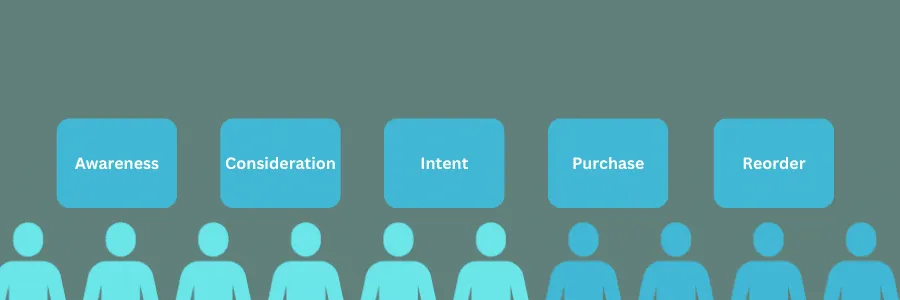
Customer purchase cycles are an ideal opportunity to create automated email campaigns that are triggered at different stages and run quietly in the background.
Pain points
We know what our customers pain points are, you need to tell them that you understand their pain and how you can help them.
A common pain point for my clients is that they are busy running their businesses, wearing many hats, they are self-taught and doing it themselves, digital activity isn’t their core strength and is hindering their growth. I need to tell them that I can help them, I provide them with the information of how they can drive their business.
Life stage
Understanding your customers life stage is more relevant to a B2C market, understanding elements such as birthdays can have a nice touch you can offer free gifts or discounts or as Pets at Home do, your pets’ birthday.
Testing your emails
Where your segment sizes are large enough to give a viable test make sure you A/B test your personalisation. With all the research in the world we are still guessing what we think our customers will react best to but carrying out tests will confirm your assumptions.
For many of these personalisation techniques a CRM would be a massive help to provide insight as well as easy implementation. If you aren’t using a CRM, you can use an email service provider to do many of the tasks with the aid of an API
Conclusion
In conclusion, effective email marketing goes beyond mere communication—it requires a thoughtful and personalised approach. By understanding your customers, tailoring content, maintaining an appropriate tone, optimising timing, and considering factors such as previous buying patterns, purchase cycles, pain points, and life stages, businesses can significantly enhance engagement and retention.
Testing these strategies and utilising tools like CRMs or email service providers with APIs further refine the personalisation process. In an era where consumers value meaningful connections, implementing these personalised email marketing strategies is not just a recommendation but a necessity for businesses aiming to thrive in the competitive landscape.
Let me know how you are getting on with your email campaigns.